Well, it wouldn’t be a photography blog without the obligatory “My Gear” post, would it? And yes, that’s right, I’m a Nikon guy.
I bought my first DSLR back in 2006 – a Nikon D40x. It had a whopping 11 megapixels! For context, the latest iPhones have 12 megapixel front-facing cameras!
The D40x served me well over the years. I got used to the setup, feel, and button/menu layout of a Nikon. Since then, I have experimented with the odd Canon camera here and there but it never felt natural to hold and I had trouble navigating the menus.
So when it came to buying a new camera, I was always going to stick with Nikon and decided on the D5300.
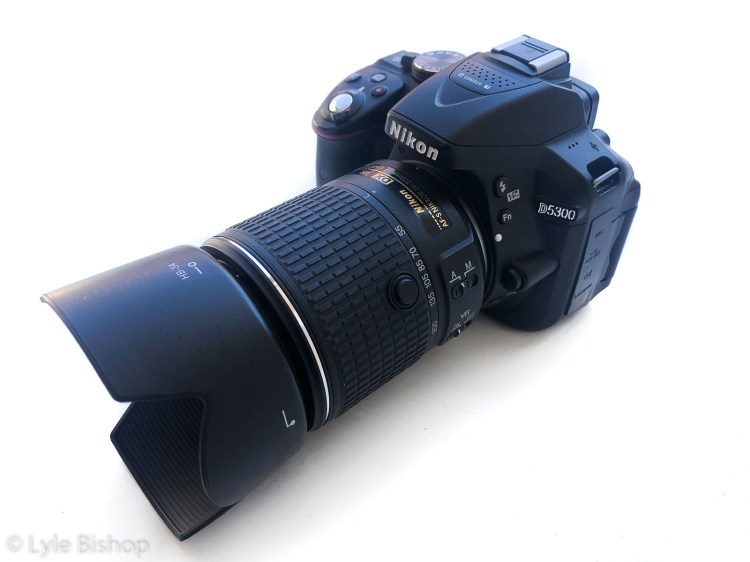
Body
Here are some basic specs on the D5300:
| Pixels | 24 megapixel |
| Image sensor | 23.5 x 15.6 mm CMOS sensor |
| ISO sensitivity | 100 to 12800 in steps of 1/3 EV |
| Lens mount | Nikon F mount (with AF contacts) |
| Video: Frame size (pixels) and frame rate | 1920 x 1080; 60p/50p/30p/25p/24p 1280 x 720; 60p/50p 640 x 424; 30p/25p |
| Monitor | 8.1 cm (3:2), approx. 1037k-dot, vari-angle TFT monitor with 170° viewing angle, approx. 100% frame coverage, and brightness adjustment |
| Dimensions (W x H x D) | 125 x 98 x 76 mm |
| Weight | Approx. 530 g with battery and memory card (no lens) |
| Wireless | Yes (IEEE 802.11b, IEEE 802.11g) |
Upgrading from the D40x was quite a leap. In addition to the high megapixel count, and the same Nikon F-mount as the D40x (which meant I could use old lenses), I was particularly interested in the vari-angle monitor. While this is often more useful for film-making (or blogging, for example), I’ve found it to be very handy when taking photos low to the ground. Not all cameras in the same price range offered the vari-angle monitor.
Lenses
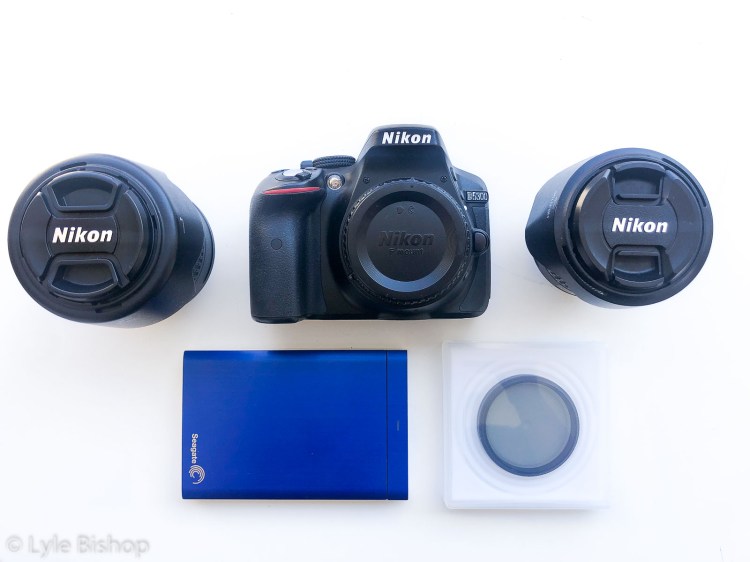
I currently have two zoom lenses:
- AF-P DX NIKKOR 18-55mm f/3.5-5.6G VR (kit lens)
- AF-S DX NIKKOR 55-200mm f/4-5.6G ED VR II
I tend to go with the 55-200mm the vast majority of the time as I really like its versatility. I’ve used it for wildlife photography, sport photography, and even for some portrait shots as it gives a cinematic bokeh effect if used at the right focal length. The 18-55mm is a good starter lens, and is useful for some architectural shots but it is rather limited.
At some point, I’m planning on getting a 35mm or 55mm prime lens. I think it will initially be a challenge using a prime lens, particularly with framing, but I think the faster speeds and increased depth of field will produce even better images than I can already produce with the zoom lenses.
Accessories
Polariser
A polarising filter is mainly used to darken skies, manage reflections, or suppress glare. I had read that it is particularly useful for nature photography, so decided to buy one before embarking on the safari. While I don’t use the polariser too often, it is good to have in the camera bag for when it is needed.
External Hard Drive
I’m including an external hard drive (in my case, the Seagate Portable Drive (500 GB)) as part of my gear because it is integral to the way I edit and store my photos pre-edit and post-edit. I shoot both RAW and JPEG and at the largest possible file size that the camera offers, so storage space is always at a premium. That’s where the external hard drive comes in. It really is a must have for any photographer.
And that’s it folks… for the time being at least.
 Lyle Bishop Photography